
 English
 Español
 Français
 Italiano
 Deutsch
 Русский
 Português
 Polski
 Română
 Svenska
 Norsk bokmål
 Suomi
 Türkçe
 العربية
 简体中文
 한국어
 हिन्दी
 Ελληνικά
Later historiography · Han dynasty, not Shang or Zhou period
Sima Qian
Sima Qian · Han historian and official
Sima Qian continued his father’s work and compiled annals, biographies, and other writings in the Shiji.
Museum documentation · free public access, no account required.
Reconstruction · Declared visual hypothesis
AI-recreated portrait of Sima Qian. The clothing draws on the historical context of the label; the face, the age represented, the colouring and the details not preserved are interpretive. It is not an authentic photograph nor a scientific facial reconstruction.
Tracekeepers
History and context
Sima Qian continued the historical project of his father, Sima Tan. He worked at the court of Emperor Wu and assembled annals, tables, treatises and biographies in the Shiji.
His entry expands the China room towards the Han period. He lived many centuries after the earliest states in this collection: his reports on earlier peoples and kingdoms must be read as later historiography, not as memories of someone who witnessed all those events.
Evidence and interpretation
He writes from the Han political world and uses materials of unequal antiquity. His reports on Wiman are a Chinese source, not an indigenous testimony from Gojoseon.
AI-recreated portrait of Sima Qian. The clothing draws on the historical context of the label; the face, the age represented, the colouring and the details not preserved are interpretive. It is not an authentic photograph nor a scientific facial reconstruction.
Catalogue facts
- Chronology
- c. 145–c. 86 BCE · approximate dates
- Place and trajectory
- Western Han court, China
- Work
- Shiji · 130 chapters
- Context
- Later historiography · Han dynasty, not Shang or Zhou period
A closer look
About 1 min to read · 3 sections. Further reading and sources · free access. Editorial review recorded: .
His father's commission
Chapter 130 of the Shiji presents Sima Tan asking his son to continue his work. The work explains its origin through a family obligation and the consultation of documents. It is the autobiographical account transmitted within the book itself, not a conversation we could reconstruct outside it.
A work he did not want to abandon
In the letter to Ren An attributed to Sima Qian, he explains why he continued living and writing after a humiliating punishment related to his defence of General Li Ling. He did not want to leave the work unfinished. The selection published by Columbia allows us to read this personal justification, without treating it as independent access to all his thoughts.
How his figure came to be represented
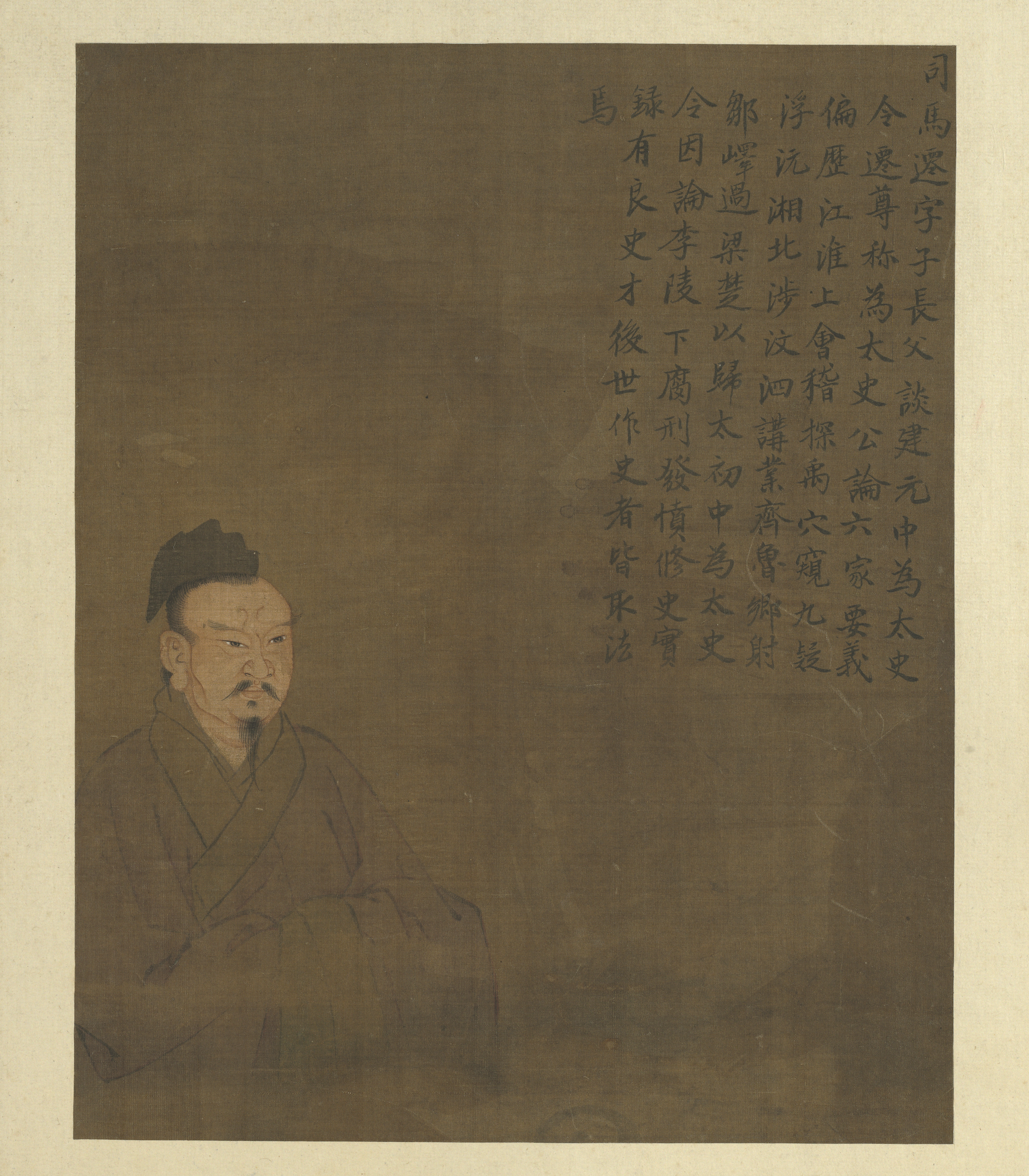
The image comes from an album of celebrated figures conserved in the National Palace Museum. The consulted label does not fix author or date for this silk painting. We therefore show its provenance and limits: it documents a way of remembering the historian, not the verified appearance of a Han court person.
- Museum · National Palace Museum · 歷代聖賢半身像 冊 司馬遷Access recorded: .
Reference images and provenance
This image documents how the author's work was represented or transmitted. It is not presented as an exact portrait, autograph, or reference for a generated face. The caption distinguishes the date of the author from the date of the image.
 View full-size reference ⛶
Documentary comparison · not recorded as an image used to create the portrait
Silk painting from the album 歷代聖賢半身像. Author and date not specified in the consulted label; it is not presented as a portrait made from life.
Silk painting from the album 歷代聖賢半身像. Author and date not specified in the consulted label; it is not presented as a portrait made from life.
Contextual image · Contextual correspondence
Author not indicated · The National Palace Museum, Taipei · The National Palace Museum, Taipei · www.npm.gov.tw · Inventory: 中畫00032800015
Additional visual documentation
A cited publication does not establish which image was used to create the character.
Where it is held
The National Palace Museum, Taipei · www.npm.gov.tw
Reference material evidence · Documented collection
Preserves the visual reference, not personal remains of the author. Public display may change.
The holding institution is documented; public display may change. Check its official record before visiting.
Sources and references
Did you enjoy this exhibit?
Your opinion helps us improve the museum. You can change it whenever you like.
Loading your rating…