
 English
 Español
 Français
 Italiano
 Deutsch
 Русский
 Português
 Polski
 Română
 Svenska
 Norsk bokmål
 Suomi
 Türkçe
 العربية
 简体中文
 한국어
 हिन्दी
 Ελληνικά
DOOR 03 · ASIA · EXCHANGE
Vedic India
Bantu-speaking coasts within the Indian Ocean
Continues in the Vedic India museum
Museum documentation · free public access, no account required.
Generated reconstruction · Declared visual hypothesis
DATED MEDIEVAL ROUTES; NO DIRECT CONTACT WITH HARAPPA OR VEDIC INDIA
Why this doorway leads to another museum
Archaeology and genetics place Swahili cities within medieval networks that moved pottery, beads, textiles, metals and people between East Africa and South Asia.
Why this gateway calls for caution: Do not link Harappa or the Vedas directly to Kilwa, or explain Swahili society as a foreign foundation.
Period of the connection: Mainly 8th–15th centuries CE
BEFORE YOU ENTER
An introduction to Vedic India
Find your place in time, explore the changes and choose where to go next.
- When
- c. 1500–1000 BCE · SOUTH ASIA
- Where
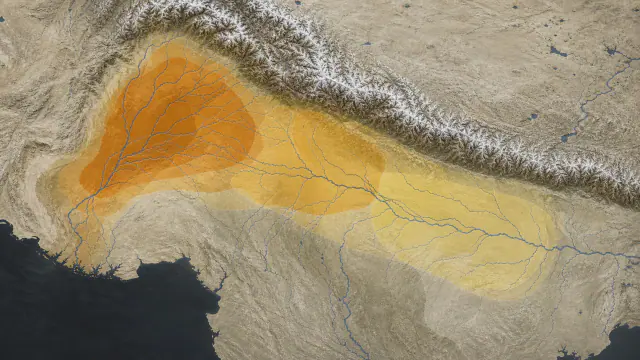
- Punjab, the north-west of the subcontinent and, later, the Ganges plain.
- What this collection brings together
- Linguistic and ritual tradition · regional societies
This is a cultural and historical trajectory, not a single empire. Orally preserved Vedic traditions participated in the formation of later kingdoms, religions and intellectual systems.
The composition and oral transmission of the Vedas fixed a ritual corpus with enormous precision for centuries, before manuscripts became their primary medium.
PLACE MATTERS
Territory and connections
Punjab, the north-west of the subcontinent and, later, the Ganges plain. Northern India and, in later centuries, cultural and religious networks across much of Asia.
A HISTORY OF CHANGE
The main periods
Dates are approximate. Periods help us navigate the past, but their boundaries were not always the same in every region.
c. 1500–1200 BCE
Rigvedic landscape
The oldest layers of the Rigveda evoke rivers of the northwest; it is a diffuse textual geography, not the border of a single people.
c. 1200–800 BCE
Kuru-Pañcāla and later Vedic period
The ritual and political focus shifts eastward; language, rite and sovereignty do not form a single territorial layer.
c. 800–600 BCE
Ganges expansion
Agriculture, iron and settlements spread across the Ganges with regional rhythms and multiple populations.
c. 600–321 BCE
Mahājanapadas
Multiple oligarchic republics and kingdoms occupy the north; they must not be merged into a supposed Vedic empire.
Continue the story: 2 more periods
321–185 BCE
Maurya Empire
The Mauryas integrated much of the subcontinent, but it was not a “Vedic empire” and Brahmanical, Buddhist, Jain and local traditions coexisted.
from 185 BCE
Post-Mauryan worlds
Regional kingdoms and religious and intellectual networks overlap; cultural influence must not be turned into a single border.
BEYOND THE DATES
How people lived and saw the world
How they were organised
The Rigveda shows chiefdoms, lineages and alliances expressed through terms such as rājan and jana, not a territorial state with mapped borders. Hymn 7.18 celebrates Sudās from the perspective of his victors.
In the later Vedic phase, Kuru-Pañcāla is better understood as a changing political and ritual formation. The standardisation of ceremonies may have reinforced hierarchies, but we do not preserve an administrative structure comparable to that of an empire.
What daily life was like
Learning a recitation required years of listening, repetition and accent control; that discipline was part of the life of specific specialists, not of all inhabitants of northern India.
Wattle-and-daub houses, grain, animal bones and excavated tools offer another scale: cooking, cultivating and repairing. Combining both records allows us to show a plural society without making the priest the universal everyday person.
What they knew how to do
The iron tools of Atranjikhera belong to a sequence where copper, bone and other materials continued. Agricultural expansion cannot be attributed to a single object or an inaugural date.
The Śulbasūtras turn strings, stakes and bricks into procedures for constructing altars of equivalent shapes. It is mathematics situated in a ritual obligation, not a modern manual separated from its ceremonial purpose.
What they believed
The yajña coordinated recitation, manual actions, fire, offerings and patronage. The Hotṛ, adhvaryu and other specialists were not interchangeable: their repertoires and responsibilities varied according to the rite.
Soma appears in the corpus as a plant, juice, offering and deity. The verses describe pressing and filtering in great detail, although they do not allow for the safe selection of a current botanical species.
Who they interacted with
Rivers connected pastures, settlements and circulation zones, but a hydronym is not in itself a demonstrated trade route. The hymns show mobility and gifts more clearly than institutionalised markets.
The arrival and use of materials such as iron, woods and ceramics must be reconstructed through distribution and context. Similar objects between sites prove contact or shared practices before political control.
Art, music and storytelling
Tonal height, duration and the sequence of syllables were part of the recited text, not an added ornament. The Sāmaveda developed sung configurations that require distinguishing voice, formula and ritual context.
A sound installation can show variants of recitation without inventing an orchestra. The vocal gesture and disciplined listening offer a more faithful image than undocumented instruments for each stop.
PEOPLE AND TESTIMONIES
Meet the people
The records distinguish historical figures, representations and reconstructions. They explain their context, the available sources and their connections with other people.
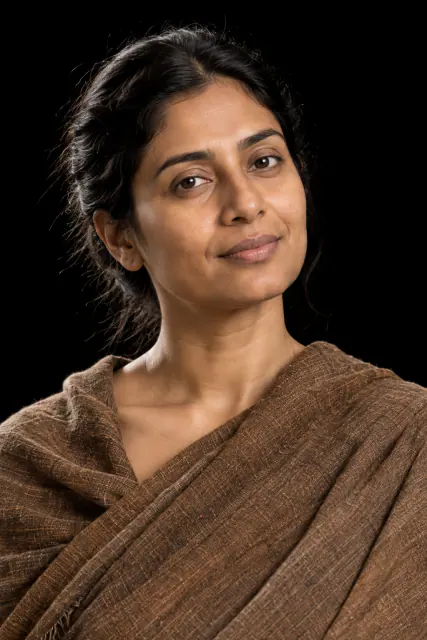
Vāc Ambhṛṇī
The tradition attributes to Vāc Ambhṛṇī a hymn whose voice is identified with the power of the word.
Read the record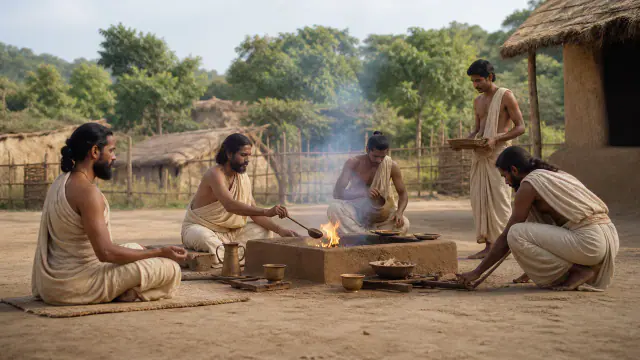
Hotṛ and Adhvaryu
While one officiant recited, others prepared the fire, measured or performed the actions of the rite.
Read the record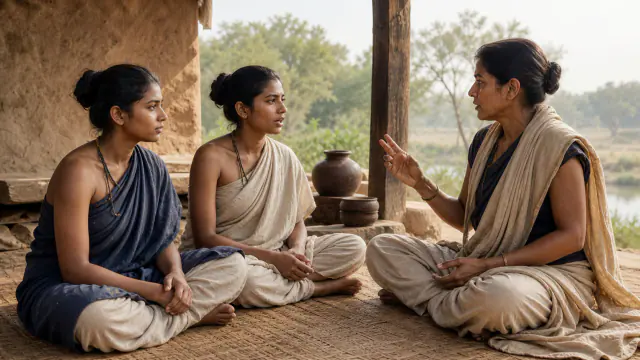
A Vedic reciter
A specific ancient scene to explain a transmission tradition that remains alive.
Read the record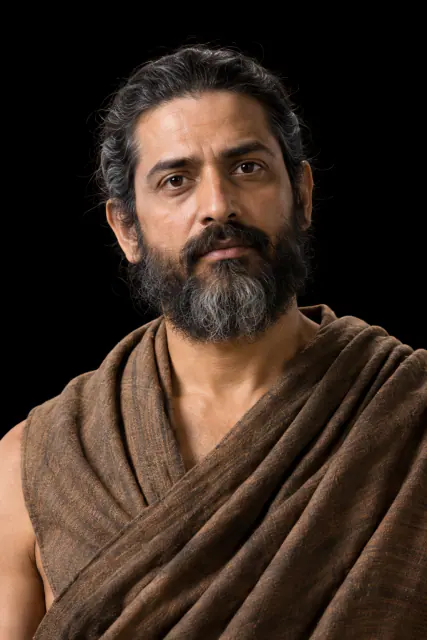
Pāṇini
Pāṇini organised in concise rules how the sounds and words of Sanskrit are formed.
Read the recordLOOK CLOSER
Objects and places to start with
A selection from the destination museum. Open each record to explore its documentation and images.
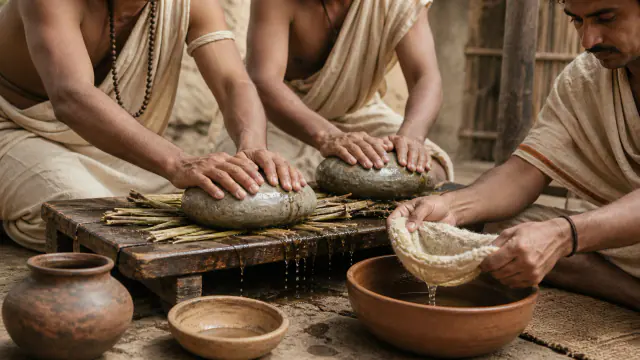
Soma stones
The texts explain how soma was prepared, but do not allow its plant to be identified with certainty.
Read the record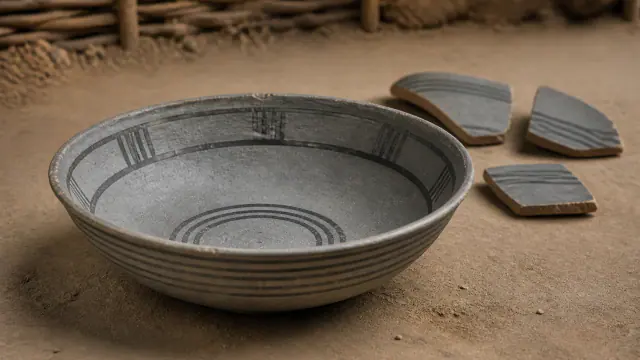
Grey bowl from Hastinapura
These grey vessels with geometric drawings are not sufficient to identify their users with a people from the texts.
Read the record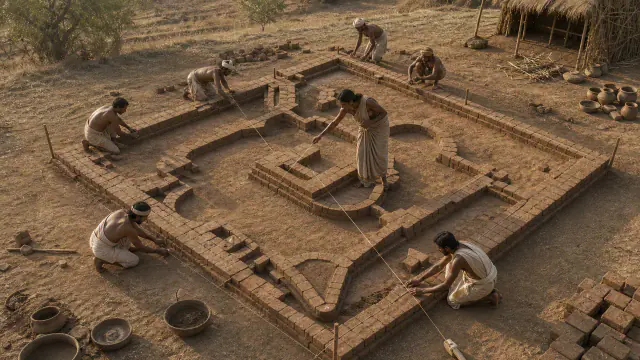
The altar cord
Cords and stakes made it possible to lay out altars and transform geometric shapes while preserving their area.
Read the record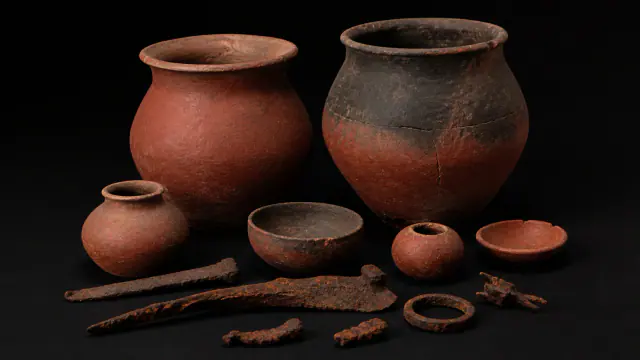
Urns from Adichanallur
The burials of Adichanallur are shown as a regional comparison, not as identified Vedic tombs.
Read the recordWHAT REMAINS
Its legacy and ongoing research
Languages, ritual practices and philosophical debates contributed to Hindu, Buddhist and Jain traditions, among others, without exhausting Indic diversity.
CHOOSE YOUR NEXT STOP
Inside this museum
Sources for this introduction
Each theme links to its documentation. The full bibliography also brings together sources for the chronology, the people and the connection between the museums.
View all sources and references →Evidence and interpretation
Evidence level of the connection: indirect. The door describes exchange; it does not turn two distinct cultures into one nor presuppose automatic ethnic continuity.
Catalogue facts
- Contact period
- Mainly 8th–15th centuries CE
- Destination museum
- Vedic India / Indic traditions
- Link Type
- exchange
- Level of evidence
- indirect
- Destination region
- South Asia
A closer look
About 1 min to read · 1 section. Further reading and sources · free access. Editorial review recorded: .
Asian connections could also have existed earlier
The models of the 2023 coastal DNA study are compatible with persons of Persian and Indian ancestry already mixed who later had offspring with local African populations. The authors cannot decide between a single stream of travellers and several with similar proportions. The hypothesis broadens the trajectory: a connection with South Asia does not require that each person arrived directly from India to the African port where their descendants lived. It concerns medieval relations modelled from concrete samples, independent of the much earlier chronologies of Harappa or the Vedic texts.
Location and territory
REGIONAL AREA
From Punjab and northwest toward the Gangetic plain, with regional rhythmsFrom Punjab and the north-west towards the Ganges plain, with regional rhythms. The footprint indicates the indicative centre of the sphere, not a border or an exact point.Cultural connections
Sources and references
- Royal Museum for Central Africa · Culture and Society
- Antiquity / Cambridge University Press · The Painted Grey Ware of India
- Nature · Entwined African and Asian genetic roots of medieval peoples of the Swahili coast, 2023
- The Met · South Asia, 1000 BCE–1 CE
- Heidelberg Asian Studies Publishing · Die Zehnkönigsschlacht am Ravifluß
- University of Göttingen, GRETIL · Ṛgveda Padapāṭha, Maṇḍala 7
- Archaeological Survey of India · Excavations at Hulas and PGW synthesis
- The Metropolitan Museum of Art · South Asia, 2000–1000 B.C.
- Indian Academy of Sciences Repository · Ritual geometry in India
- Government of India, Vedic Heritage Portal · Rigveda Saṃhitā
- IGNCA · The Vedic Age
- UNESCO · Vedic oral preservation techniques
- IGNCA · Puṣpasūtra, a Prātiśākhya of the Sāmaveda
- University of Göttingen, GRETIL · Ṛgveda Padapāṭha, Maṇḍala 10
- The Met · The Year One, Indian royal plaque
- IGNCA · Concept of Time in Vedic ritual
- IGNCA · Oral Tradition of the Vedas
- Central Sanskrit University · Sanskrit and Pāṇini
- University of Göttingen, GRETIL · Pāṇini, Aṣṭādhyāyī
- Indira Gandhi National Centre for the Arts · Pāṇini and grammatical tradition
YOUR NEXT VISIT
Explore Vedic India
The same collection, two ways to explore. Choose the experience that suits you.
Did you enjoy this exhibit?
Your opinion helps us improve the museum. You can change it whenever you like.
Loading your rating…