
 English
 Español
 Français
 Italiano
 Deutsch
 Русский
 Português
 Polski
 Română
 Svenska
 Norsk bokmål
 Suomi
 Türkçe
 العربية
 简体中文
 한국어
 हिन्दी
 Ελληνικά
HISTORICAL FIGURE · WHO WROTE THESE HISTORIES
Thucydides
Thucydides · Athenian historian and general
Thucydides wrote about the Peloponnesian War, in which he participated as an Athenian general.
Museum documentation · free public access, no account required.
Reconstruction · Declared visual hypothesis
AI-generated portrait of Thucydides. The clothing is based on the historical context of the entry; the face, age represented, colouring and details not preserved are interpretive. It is not an authentic photograph nor a scientific facial reconstruction.
Tracekeepers
History and context
Thucydides wrote about a war in which he had participated. He was an Athenian general, fell ill during the epidemic in his city and spent twenty years in exile. The experience gave him information, but also personal motives for explaining what happened.
In recounting what occurred between Athenians, Spartans and Thracians, he sought to contrast reports. His work distinguishes problems of memory and disagreements between witnesses. His speeches, however, are literary reconstructions and not records of what each person said.
Evidence and interpretation
There is no undisputed modern diagnosis for the epidemic described. Narrating Pericles' speeches does not demonstrate a personal friendship with him.
AI-generated portrait of Thucydides. The clothing is based on the historical context of the entry; the face, age represented, colouring and details not preserved are interpretive. It is not an authentic photograph nor a scientific facial reconstruction.
Catalogue facts
- Chronology
- c. 460 BCE–after 404 BCE · uncertain death
- Place and trajectory
- Athens
- Work
- History of the Peloponnesian War
- Context
- Athenian historian and general
A closer look
About 1 min to read · 3 sections. Further reading and sources · free access. Editorial review recorded: .
Fall ill and observe
In II.48 he says he suffered the disease that swept through Athens and observed other people who were ill. He prefers to register how it manifested itself rather than declare its origin resolved. It is an exceptional testimony of personal experience. It also has limits: the words of an ancient description are not sufficient to assign, without discussion, the name of a disease from our manuals.
Listening from exile
In V.26 he relates his twenty years of exile to the command at Amphipolis. He says he could have learnt news from both sides, especially from the Peloponnesians. His absence from Athens altered his life and also his research possibilities. The balance is his: he explains how he turned a personal setback into an advantage for writing.
How far his testimony reaches
The same passage affirms that he lived through the whole war and organised the facts by summers and winters. For this reason it is more prudent to date him as alive after the end of the war than to fix a secure year of death. Proximity to the events improves some observations, but does not eliminate the historian's selection and interpretation.
Reference images and provenance
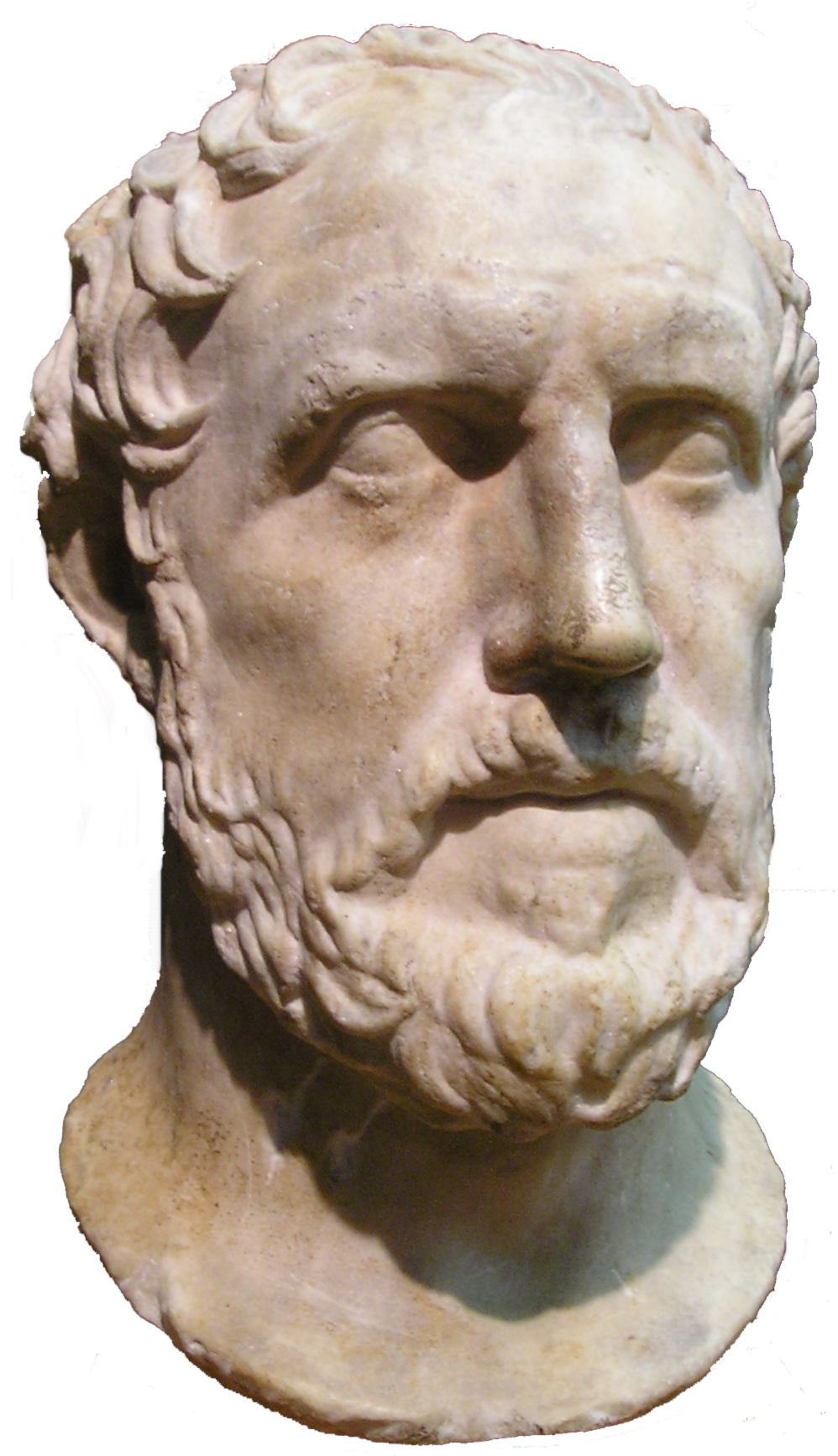
This image documents how the author's work was represented or transmitted. It is not presented as an exact portrait, autograph, or reference for a generated face. The caption distinguishes the date of the author from the date of the image.
 View full-size reference ⛶
Documentary comparison · not recorded as an image used to create the portrait
Marble head of the Royal Ontario Museum, probably a late Hellenistic copy of a lost Greek original from the beginning of the fourth century BCE. The published image already had the background removed.
Marble head of the Royal Ontario Museum, probably a late Hellenistic copy of a lost Greek original from the beginning of the fourth century BCE. The published image already had the background removed.
Contextual image · Contextual correspondence
Captmondo · photograph of 9 July 2005 · Royal Ontario Museum

Additional visual documentation
A cited publication does not establish which image was used to create the character.
Where it is held
Royal Ontario Museum
Reference material evidence · Documented collection
Preserves the visual reference, not personal remains of the author. Public display may change.
The holding institution is documented; public display may change. Check its official record before visiting.
Sources and references
Did you enjoy this exhibit?
Your opinion helps us improve the museum. You can change it whenever you like.
Loading your rating…