
 English
 Español
 Français
 Italiano
 Deutsch
 Русский
 Português
 Polski
 Română
 Svenska
 Norsk bokmål
 Suomi
 Türkçe
 العربية
 简体中文
 한국어
 हिन्दी
 Ελληνικά
HISTORICAL FIGURE · WHO WROTE THESE HISTORIES
Herodotus
Herodotus · Greek historian
Herodotus gathered accounts about Greeks, Persians and other peoples to investigate their conflicts and customs.
Museum documentation · free public access, no account required.
Reconstruction · Declared visual hypothesis
AI-recreated portrait of Herodotus. The clothing draws on the historical context of the label; the face, the age represented, the colouring and the details not preserved are interpretive. It is not an authentic photograph nor a scientific facial reconstruction.
Tracekeepers
History and context
Herodotus was born in a Greek city in Asia Minor that was under Persian power. He wished to understand the conflicts between Greeks and Persas, but in his Histories he also gathered news about rivers, cults and ways of life. He asked, compared answers and preserved versions that he did not always accept.
His accounts appear in several rooms of this museum. Here you can meet the one who wrote them: a Greek author who chose how to present the words of his informants, not a neutral voice of all the peoples he described.
Evidence and interpretation
Distinguish what he says he saw, what he was told and his own explanations. An ancient account does not by itself equal an archaeological verification.
AI-recreated portrait of Herodotus. The clothing draws on the historical context of the label; the face, the age represented, the colouring and the details not preserved are interpretive. It is not an authentic photograph nor a scientific facial reconstruction.
Catalogue facts
- Chronology
- c. 484–c. 425 BCE · approximate dates
- Place and trajectory
- Halicarnassus, Asia Minor
- Work
- Histories
- Context
- Greek historian
A closer look
About 1 min to read · 3 sections. Further reading and sources · free access. Editorial review recorded: .
A Greek author remembered in Rome
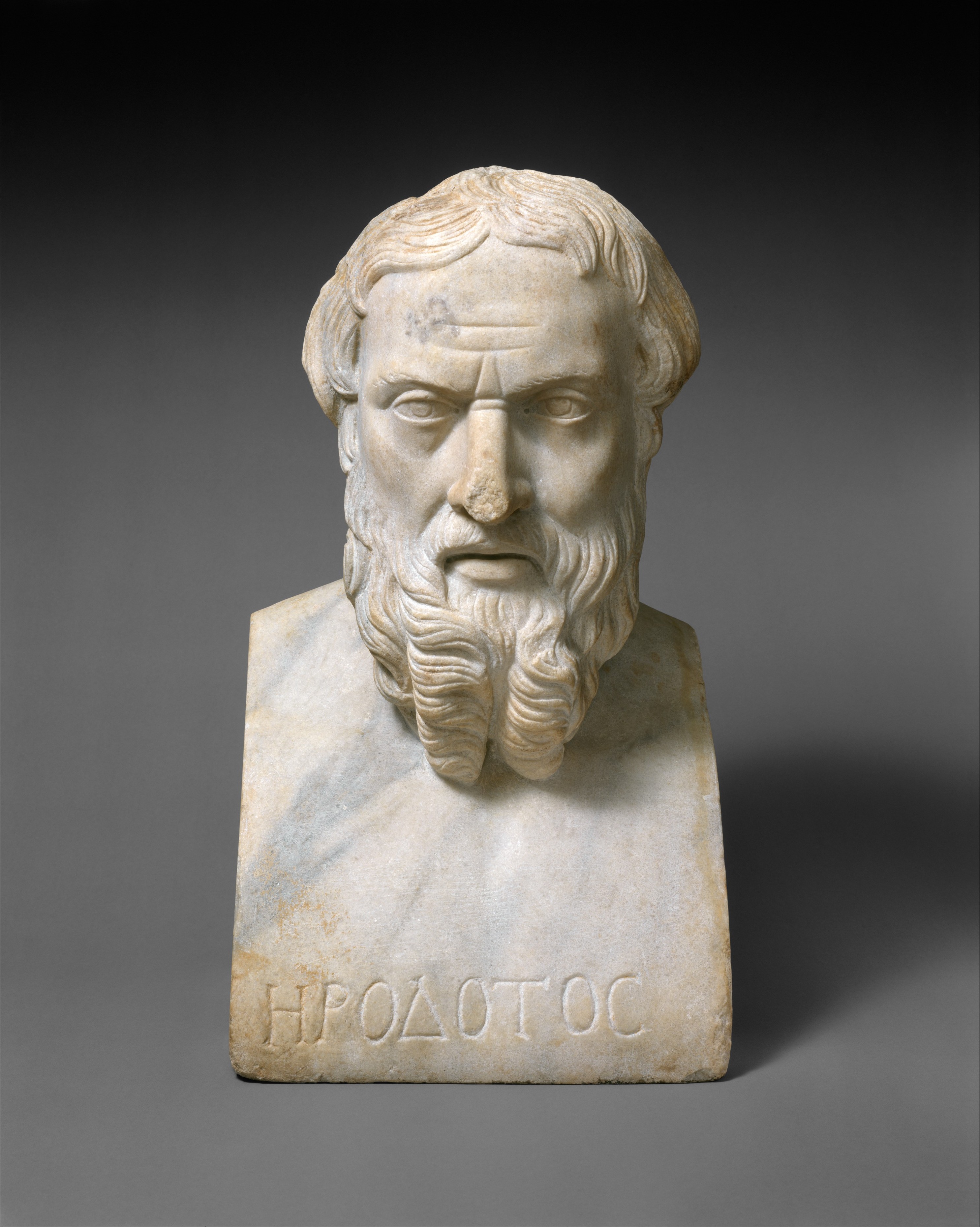
The statue you see was not carved during his lifetime. The Met dates this bust to the second century CE and relates it to a Greek model from the first half of the fourth century BCE. Roman readers continued to recognise Herodotus many centuries later: his image formed part of a culture that preserved and discussed Greek authors.
- Museum · Metropolitan Museum · bust of Herodotus, 91.8Access recorded: .
Asking about the Nile
In Histories II.19–27 he asks why the Nile rises in summer. He examines explanations and objects to what does not convince him. The value lies in being able to follow his questions; we must not turn the answers he proposes into current knowledge about the river. The work allows us to study both the information gathered and the way in which its author reasoned about it.
- Ancient text · Herodotus · Histories II.19–27 and II.44, Godley, LoebAccess recorded: .
Translating can also change meaning
In II.44 he says he consulted priests of Tyre about the antiquity of a sanctuary and compared their reports with those from Thasos. He calls Heracles the god of Tyre: he makes a foreign cult comprehensible by means of a Greek name. This equivalence is part of his interpretation. The ages transmitted by the priests are also not independent archaeological datings.
- Ancient text · Herodotus · Histories II.19–27 and II.44, Godley, LoebAccess recorded: .
Reference images and provenance
This image documents how the author's work was represented or transmitted. It is not presented as an exact portrait, autograph, or reference for a generated face. The caption distinguishes the date of the author from the date of the image.
 View full-size reference ⛶
Documentary comparison · not recorded as an image used to create the portrait
Second-century CE Roman bust, copy of a Greek type postdating Herodotus' life. Does not certify his exact appearance.
Second-century CE Roman bust, copy of a Greek type postdating Herodotus' life. Does not certify his exact appearance.
Contextual image · Contextual correspondence
Anonymous sculptor · photograph of the Metropolitan Museum of Art · The Metropolitan Museum of Art · Inventory: 91.8
Additional visual documentation
A cited publication does not establish which image was used to create the character.
Where it is held
The Metropolitan Museum of Art
Reference material evidence · Documented collection
Preserves the visual reference, not personal remains of the author. Public display may change.
The holding institution is documented; public display may change. Check its official record before visiting.
Sources and references
Did you enjoy this exhibit?
Your opinion helps us improve the museum. You can change it whenever you like.
Loading your rating…