
 English
 Español
 Français
 Italiano
 Deutsch
 Русский
 Português
 Polski
 Română
 Svenska
 Norsk bokmål
 Suomi
 Türkçe
 العربية
 简体中文
 한국어
 हिन्दी
 Ελληνικά
05 · Organic object · Possible game
Rubber before the stadium
The rubber balls of El Manatí and an elastic technology
The balls preserve an ancient way of working rubber, but not the rules with which they were used.
Museum documentation · free public access, no account required.
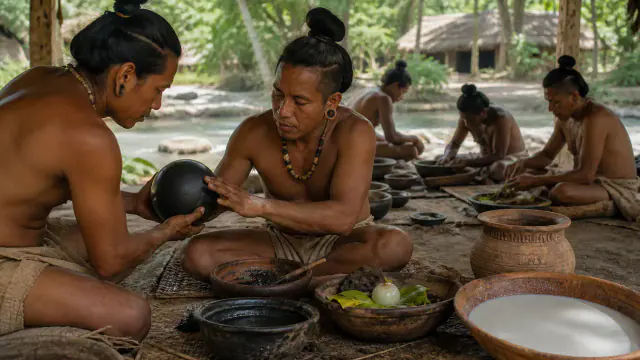
Generated reconstruction · Declared visual hypothesis
Declared visual reconstruction for museographic context; it is not a photograph of the original nor documentary evidence.
History and context
Rubber balls found at El Manatí show that Gulf communities mastered a bouncing material very early. In a region whose later Nahuatl name, Olman, alludes to rubber, the discovery links tropical environment, technical knowledge and bodily action.
It is tempting to imagine a full match, but the balls appeared in an offering context and not alongside a preserved court. They may signal play, ritual or both; no rule, marker or result came with them.
That a ball retains bounce implies knowledge of latex collection and transformation, plus control over shape and drying. At El Manatí, the wetland preserved a technical product that in other settlements could have existed without leaving visible trace.
The balls appeared as offerings, not inside an excavated court. Their presence connects elastic material and bodily action at an early date, but the rules, participants and consequences of any associated game remain outside the record.
Evidence and interpretation
Documented fact: ancient rubber balls were recovered at El Manatí, early evidence of the use of this material. Interpretation and caution: they are not sufficient to demonstrate that the ball game was played there with the forms, courts or sacrifices known in later periods. Expanded documentation: El Manatí provided rubber balls dated to the Early Formative, among the oldest Mesoamerican evidence of this material. Expanded interpretation and caution: A ball does not demonstrate a court, a uniform rule set or sacrifices linked to outcome; play and offering must be distinguished.
Catalogue facts
- Narrative date
- c. 1600–1200 BCE for the oldest specimens
- Location
- El Manatí, Veracruz, Mexico
- Material
- Natural rubber preserved in a wet environment
- Context
- Organic technology, bodily action and offering
- Curatorial reading
- The documented fact and its interpretation appear separately in the evidence block.
- Evidence
- Archaeological context, materiality and chronology.
- Caution
- Do not convert stylistic diffusion or contact into political domination.
- Documentary coverage
- 3 museum, heritage, primary corpus or research sources for this stop.
A SHARED TOPIC, DIFFERENT MOMENTS
Objects connected through time
Follow a topic across the collections. A shared tag is a way to compare objects, not proof that one culture influenced another.
The order uses the midpoint of each approximate date range; ranges can overlap. Spacing does not represent elapsed time. Swipe, scroll or use the arrows. With the sequence focused, use ← / →, Home or End.
Rubber1 dated object
A closer look
About 1 min to read · 1 section. Further reading and sources · free access. Editorial review recorded: .
Check properties with new materials
Dorothy Hosler and Michael Tarkanian experimentally studied how rubber properties change when varying the proportion of latex and juice of a vine. They tested elasticity, wear resistance and shock absorption: the mixtures were not equally suitable for a ball, a sole or an adhesive. As archaeological rubber is highly degraded, they used materials obtained in Mexico to make modern samples. The results published in 2010 demonstrate technical processing possibilities, not the exact recipe of each El Manatí ball. The comparison distinguishes experimental analysis from conservation of the ancient object.
- Research · MIT News · A good many years before GoodyearAccess recorded: .
Location and territory
APPROXIMATE LOCATION
El Manatí · MexicoApproximate marker of the ritual spring.Where it is held
INAH · INAH Veracruz Centre
Component of the group · Documented collection
INAH documents the conservation of the El Manatí collection and temporary loans of three originals in 2026; the entire assemblage is not assigned to those temporary museums.
The holding institution is documented; public display may change. Check its official record before visiting.
Sources and references
Did you enjoy this exhibit?
Your opinion helps us improve the museum. You can change it whenever you like.
Loading your rating…