
 English
 Español
 Français
 Italiano
 Deutsch
 Русский
 Português
 Polski
 Română
 Svenska
 Norsk bokmål
 Suomi
 Türkçe
 العربية
 简体中文
 한국어
 हिन्दी
 Ελληνικά
ARCHITECTURE AND LANDSCAPE · 01
Great Zimbabwe: dry stone, power and long-distance connections
The granite walls, built without mortar, were part of a city connected to the African interior and the Indian Ocean.
Museum documentation · free public access, no account required.
Reconstruction · Declared visual hypothesis
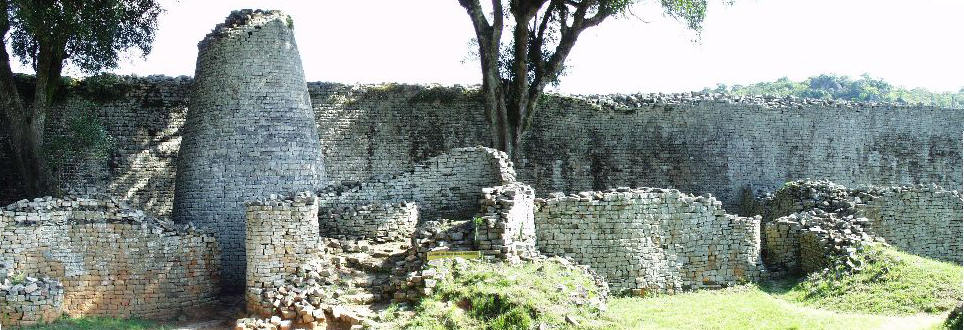
AI reconstruction with changes to the camera view and restoration of upper details and ground, based on a photograph by Marius Loots, CC BY-SA3.0. Attribution does not imply that the photographer endorses the hypothesis. This is not a measured elevation.
Tracekeepers / OpenAI ImageGen; photographic reference: Marius Loots · CC BY-SA 3.0
History and context
Enclosures of unmortared granite blocks, the hill and the valley shaped a city connected to regional and Indian Ocean networks. UNESCO and NMMZ record three main sectors, dry-stone architecture, imported materials and soapstone birds.
Reading the landscape: Combine a terrain model, granite sources, livestock routes and finds; the wall is not presented as an isolated backdrop.
Evidence and interpretation
Documented fact: UNESCO and NMMZ record three main sectors, dry-stone architecture, imported materials and soapstone birds. Caution: Reject colonial narratives that denied African authorship; do not assert an exact population, a single function or an unchanging ethnicity.
Catalogue facts
- Place and period
- Masvingo, Zimbabwe; c. 1100–1450
- Custodianship
- National Museums and Monuments of Zimbabwe; Great Zimbabwe Museum, in situ.
- Caution
- Reject colonial narratives that denied African authorship; do not assert an exact population, a single function or an unchanging ethnicity.
A closer look
About 1 min to read · 1 section. Further reading and sources · free access. Editorial review recorded: .
The earth that disappeared from a stone city
The conservation history recorded by ICCROM recalls that in 1915, earth platforms, benches, and walls of the western hill enclosure were destroyed under the mistaken idea that their weight threatened the stone walls. That intervention altered what we today perceive as Great Zimbabwe’s architecture. The earth remains formed part of inhabited spaces, while some stone walls supported terraces or platforms. The current visual predominance of masonry therefore reflects both historical construction and later losses caused by conservation decisions.
Reference images and provenance
 View full-size photograph ⛶
Photograph of the surviving remains; uploaded in 2007, date taken unspecified. A reference for location, general proportions and masonry.
· Contextual correspondence
Marius Loots (Maeztro)

Sources and references
Did you enjoy this exhibit?
Your opinion helps us improve the museum. You can change it whenever you like.
Loading your rating…