
 English
 Español
 Français
 Italiano
 Deutsch
 Русский
 Português
 Polski
 Română
 Svenska
 Norsk bokmål
 Suomi
 Türkçe
 العربية
 简体中文
 한국어
 हिन्दी
 Ελληνικά
MAGDALENIAN · LIGHT, FAT AND ENGRAVED STONE
Lamp from La Mouthe
A lamp to light the cave
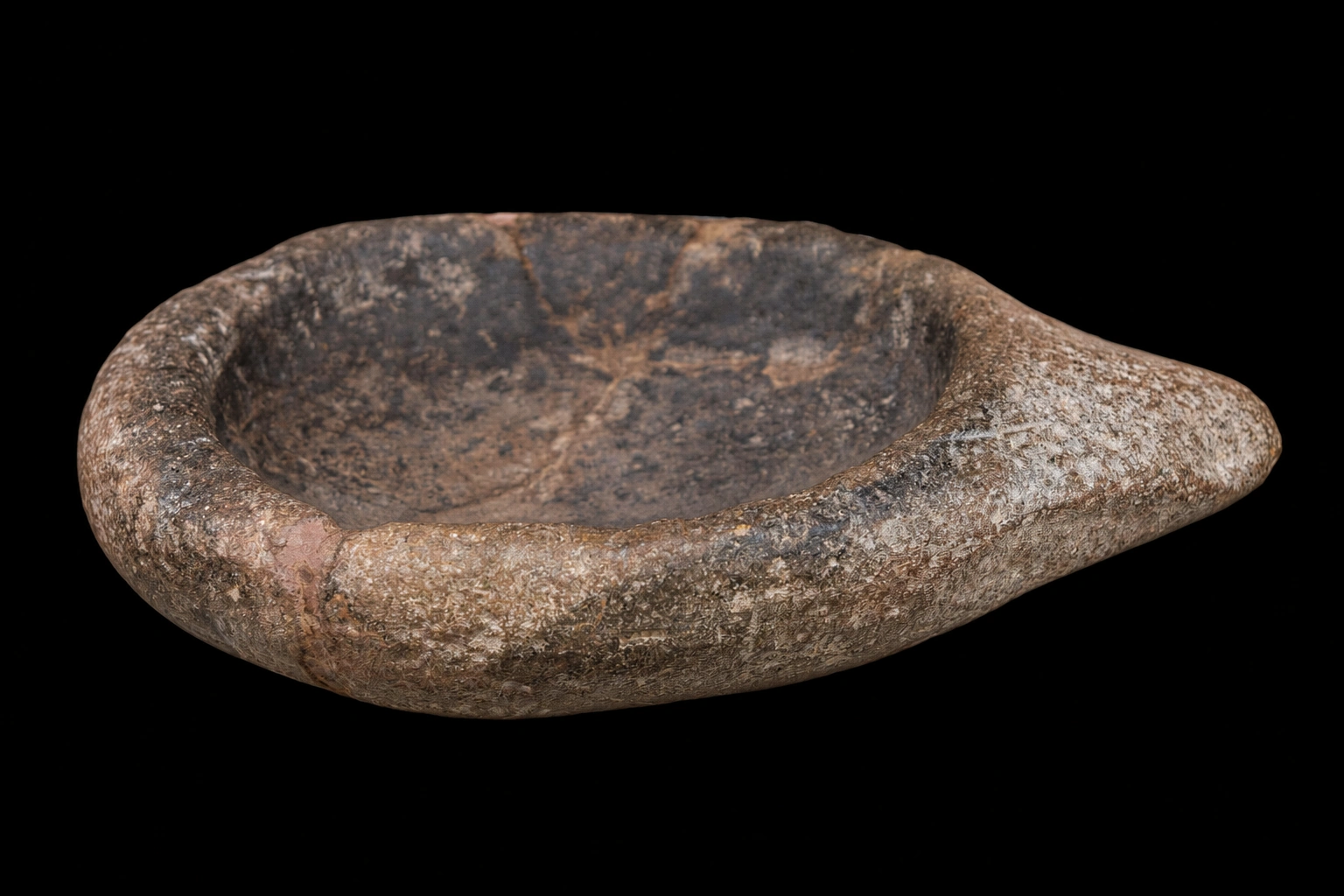
This stone lamp has an engraved ibex head on the handle.
Museum documentation · free public access, no account required.
Reconstruction · Declared visual hypothesis
Interpretive AI reconstruction from photograph by Marie-Lan Taÿ Pamart, CC BY 4.0. Changes: black background, lighting, surface cleaning and removal of modern inventory marking. Does not imply endorsement by author or museum. Not an archaeological photograph nor a certified restitution. Micro-details, finish and colour are interpretive approximations.
Tracekeepers / OpenAI ImageGen; source photograph: Marie-Lan Taÿ Pamart · Musée d’Archéologie nationale, Saint-Germain-en-Laye · Inventory: MAN 50295 · CC BY 4.0
Explore in 3D
Load the model only when you want to explore it. Drag or use the arrow keys to turn it; + and − zoom. Closing it releases its memory.
User-supplied digital reconstruction; file metadata declares Tripo. It is not an archaeological scan nor a metric replica. The display scale is indicative, not a measurement of the original; the supplied geometry is preserved intact. Interpretation of the lamp from La Mouthe. The geometry and appearance of the vessel do not prove the fuel, duration of use nor the real scale of the original.
History and context
Émile Rivière found the lamp on 29 August 1899. The red sandstone forms a bowl and a triangular handle. On the outer, slightly convex face an ibex head was engraved; residues and comparisons support its use as a fat lamp.
Mobile light changed how long could be spent underground and which surfaces could be seen. We do not know the specific fuel or wick of this piece nor whether it illuminated the images of La Mouthe on a particular occasion.
Evidence and interpretation
Bowl, handle, engraving, context and general lamp function are documented. Fuel, wick, duration and scene of use are reconstructions.
Catalogue facts
- Date
- ≈20,500–13,000 years · Magdalenian framework
- Location
- Grotte de La Mouthe · Dordogne, France
- Inventory
- MAN 50295
- Material
- Engraved red sandstone
- Measurements
- 17.1 × 12 × 4.5 cm
A SHARED TOPIC, DIFFERENT MOMENTS
Objects connected through time
Follow a topic across the collections. A shared tag is a way to compare objects, not proof that one culture influenced another.
The order uses the midpoint of each approximate date range; ranges can overlap. Spacing does not represent elapsed time. Swipe, scroll or use the arrows. With the sequence focused, use ← / →, Home or End.
Sandstone1 dated object
A closer look
About 4 min to read · 7 sections. Further reading and sources · free access. Editorial review recorded: .
A light that helped recognise Palaeolithic art
The lamp does not only speak of the people who used it. Its discovery helped to accept that the authors of Palaeolithic images could light the interior of caves. The excavation itself left a wound: a pick blow fractured it, although almost all fragments were recovered. Observing the break allows the ancient history to be separated from the history of the discovery. It also invites looking at the reverse, where the engraving is: the object holds information that a top-down view of the bowl does not show.
A small vessel that required work
The part that received the fuel was not a natural cavity simply exploited. The sandstone was worked to form a bowl of about ten centimetres in diameter and two and a half centimetres deep, together with a short handle of triangular outline. Those proportions help to imagine a manageable object, not a fixed hearth. The ibex head is engraved on the outer convex face. The same piece thus combines a surface prepared to hold fuel and another dedicated to an animal image; both decisions are part of its manufacture.
Why it was identified as a lamp
Its resemblance to a bowl was not enough to know what it served for. The French Ministry of Culture documentation states that the base contained a carbonised deposit and its analysis recognised animal fat combustion products. The interpretation therefore combines the vessel form and the use residues. It is a useful distinction when touring the museum: an object may appear suitable for an activity, but residues provide another class of proof. Here they allow the move from a visual resemblance to a function supported by the find.
Lighting a place is not the same as traversing it
In 2021 a team experimentally compared torches, fat lamps and a small fire inside a cave. Lamps proved appropriate for staying in confined spaces; torches offered advantages for moving around. The lamp could dazzle the person carrying it and left the floor less well lit. This helps to understand why several systems coexisted. There was not necessarily one object that solved walking, observing a wall and working at the same point equally well.
Duration was also part of the choice
The tested lamps maintained a more regular and longer-lasting illumination than torches, with an intensity close to a candle measured at one metre. Torches required more attention and produced residues during the traverse. They are not performances measured at La Mouthe: they depend on the replicas and conditions of the experiment. They show what had to be organised before entering: how long one wanted to stay, which area had to be lit and how to sustain the light during a prolonged activity.
Comparison with the lamp from Lascaux
The lamp from Lascaux conserved in the Musée national de Préhistoire offers a particularly clear comparison. It has an elongated handle and engraved signs that relate to others present in the cave and on an antler point. La Mouthe, by contrast, presents an animal figure. There was no single decoration for this class of objects. The French museum also highlights that lamps vary greatly in their elaboration, even within a single site. A carefully made and decorated piece does not necessarily represent the appearance of all the lights used by that community.
Seeking illumination beyond the lamps
Research into decorated caves is not limited to finding complete vessels. At Font-de-Gaume, remains of fires on the floor or on ledges are studied; in other cavities, certain black marks on the walls are linked to torch maintenance. These clues allow us to think about where light points were placed and how people moved between them. When comparing the lamp with the museum paintings, it is worth remembering that material organisation: to see a figure, the position of the light, the relief of the wall, and the vantage point also mattered.
Reference images and provenance
 View full-size photograph ⛶
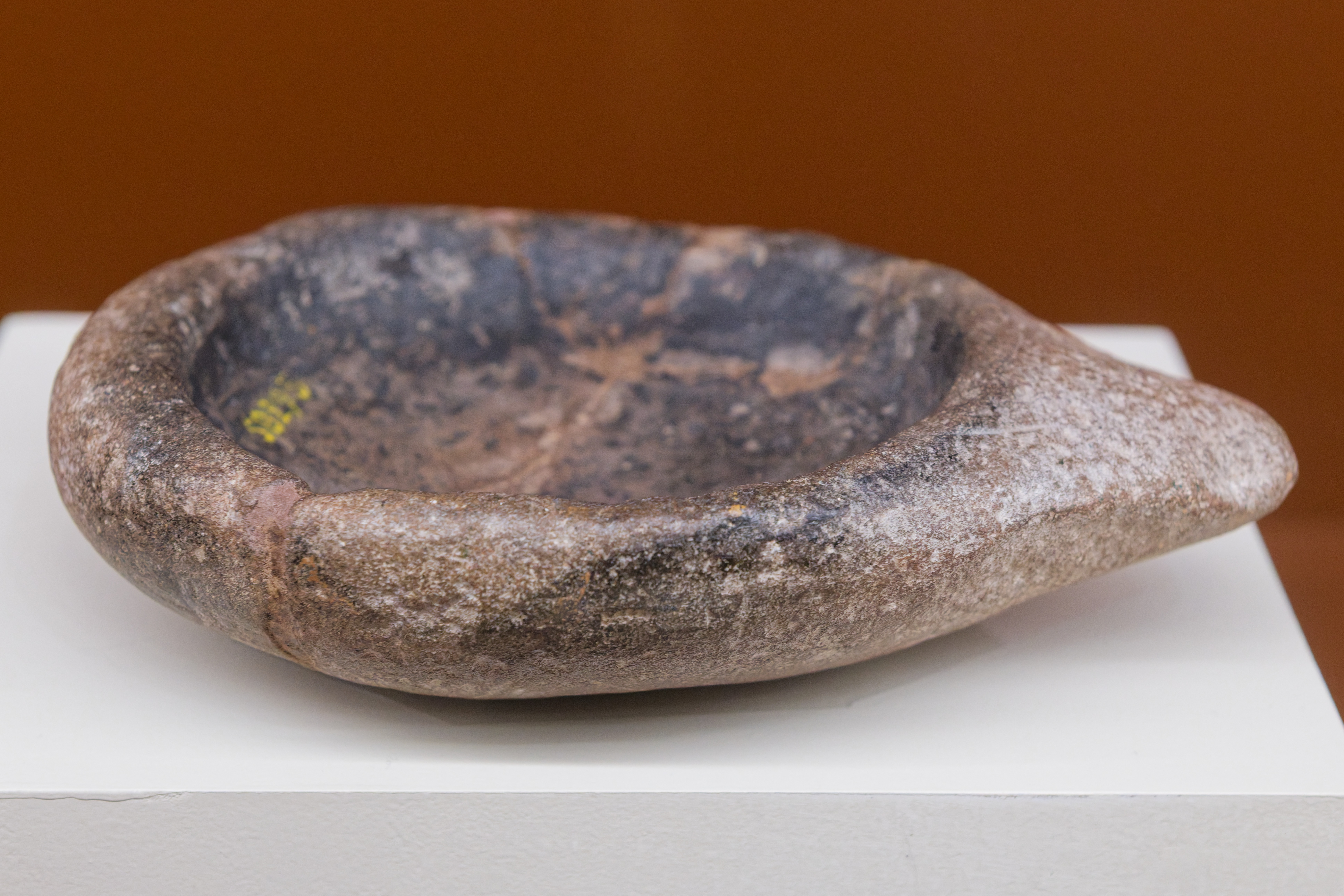
Documentary photograph without semantic retouching. Preserves the condition and visible details of the reference piece.
Documentary original · Exact correspondence
Marie-Lan Taÿ Pamart · Musée d’Archéologie nationale, Saint-Germain-en-Laye · Inventory: MAN 50295

Location and territory
LOCATED SITE
Grotte de La Mouthe · FranceCave marker in Les Eyzies.Where it is held
The holding institution is documented; public display may change. Check its official record before visiting.
Sources and references
- Musée d’Archéologie nationale · shape and engraving of the La Mouthe lamp (2023)
- French Ministry of Culture · combustion residues and Palaeolithic lighting
- Medina-Alcaide and colleagues · experimental comparison of lighting systems (PLOS ONE, 2021)
- Musée national de Préhistoire · Lascaux lamp and diversity of Palaeolithic lamps
- French Ministry of Culture · traces and layout of lighting in Font-de-Gaume
Did you enjoy this exhibit?
Your opinion helps us improve the museum. You can change it whenever you like.
Loading your rating…