
 English
 Español
 Français
 Italiano
 Deutsch
 Русский
 Português
 Polski
 Română
 Svenska
 Norsk bokmål
 Suomi
 Türkçe
 العربية
 简体中文
 한국어
 हिन्दी
 Ελληνικά
FUNERARY SCULPTURE · BASTETANIA
Lady of Baza
An ancestor seated upon her ashes
The sculpture housed within it the cremated remains of an adult woman.
Museum documentation · free public access, no account required.
Documentary original · Exact correspondence
Documentary photograph of the original or the exact site.
ANAGSPC · Own work · Inventory: Dama de Baza y ajuar de la tumba 155 de la necrópolis de Basti · CC BY-SA 4.0
History and context
Seated on a winged throne, the Lady of Baza kept the cremated remains of an adult woman in a cavity. The discovery within a tomb, alongside weapons and a rich assemblage, forced a reassessment of the automatic association between weaponry, power, and male sex.
The polychromy turns her clothing and jewellery into a scene of presence, not absence. She may represent the idealised deceased, an ancestor, or a divine figure linked to her; none of these identities can be spoken as a proper name.
Osteological analyses identify the cremated remains as belonging to an adult woman aged approximately 25 to 30 years. Four warrior panoplies in the tomb broke the old custom of automatically attributing weapons and funerary power to a male.
It is not necessary to decide whether the stone reproduces the deceased, an ancestor, or a divine figure to understand the extraordinary datum: a real woman occupied the centre of an expensive, polychrome, and politically visible ceremony.
Evidence and interpretation
Documented fact: the sculpture functioned as a cinerary urn for an adult woman and appeared in Tomb 155 with exceptional grave goods. Interpretation and caution: exact age, identity, office, and meaning of the weapons remain open; it is advisable to use the osteological range, not a closed number.
Catalogue facts
- Narrative date
- First half of the 4th century BCE
- Location
- Necropolis of Cerro del Santuario, Baza (Granada)
- Material
- Polychrome limestone · cremated remains
- Context
- Tomb 155 · funerary chamber
- Classification
- Iberian collection or explicit interpretive resource
- Visual reference
- National Archaeological Museum · Lady of Baza · visual and provenance reference
A closer look
About 1 min to read · 1 section. Further reading and sources · free access. Editorial review recorded: .
An ornament that was painted, not carved
The study published in the MAN Bulletin of 2021 revisited the Lady through digital photography and surface analysis. Its authors identify among the necklaces a motif they interpret as a knotted cord, barely perceptible because it was not carved in relief. They propose for it a possible protective meaning, without turning this reading into a secure identification. The finding shows that losing colour does not merely mean losing beauty: an entire object of representation can disappear. The paint conveyed information that the sculpture's volume alone does not preserve.
Reference images and provenance
You can enlarge the documentary photograph of the piece related to this figure. It is not listed as an input of a generated portrait. The identification of the figure, when discussed, is explained in the file.
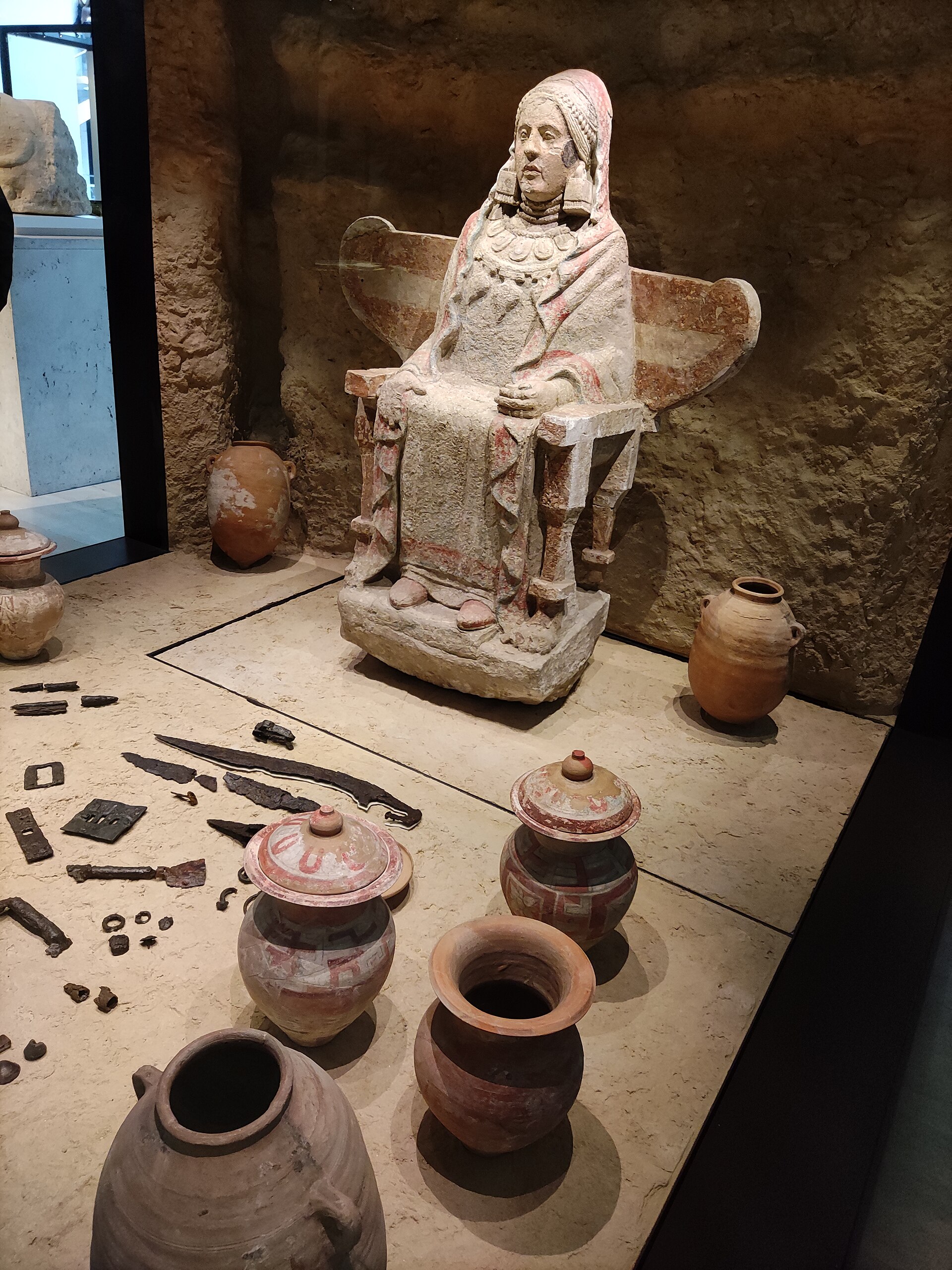 View full-size reference ⛶
Documentary photograph of the reference object
This photograph is the registered source of the documentary image currently displayed; it is not presented as an input photograph for another generated portrait.
This photograph is the registered source of the documentary image currently displayed; it is not presented as an input photograph for another generated portrait.
Documentary original · Contextual correspondence
ANAGSPC

Additional visual documentation
A cited publication does not establish which image was used to create the character.
Location and territory
LOCATED SITE
Baza · GranadaMarker of the funerary assemblage.Where it is held
Museo Arqueológico Nacional (Madrid)
Item or group in the record · Permanent exhibition
Room 11 · display case dedicated to the Lady of Baza.
The holding institution is documented; public display may change. Check its official record before visiting.
Sources and references
Did you enjoy this exhibit?
Your opinion helps us improve the museum. You can change it whenever you like.
Loading your rating…